Tattooing is not an act of mere decoration; it is a permanent commitment of the skin to a specific narrative.
However, the narratives we choose at one stage of life do not always resonate with the individuals we become. When a piece of body art no longer serves its purpose: whether due to a shift in personal philosophy, a lapse in technical execution, or the inevitable degradation of pigment over time: the solution is not always removal. Instead, we look toward transformation.
The art of the custom tattoo cover-up is a complex exercise in technical theory, spatial reasoning, and anatomical composition. It requires more than just "inking over" an old design; it is a calculated restructuring of visual information. As a realism tattoo artist in Greenville, SC, I approach every cover-up not as a repair, but as a sophisticated architectural project: we are building a new structure upon an existing foundation.
The Physics of Pigment: Understanding the Substrate
To understand the cover-up, one must first understand the physics of the medium. Tattoo ink is not a paint that sits on top of the skin; it is a collection of pigment particles suspended within the dermis. When we apply new ink over an existing tattoo, we are not "covering" it in the way a second coat of house paint covers the first. Instead, we are mixing pigments within the same layer of tissue.
This is a fundamental technical truth: pigment is additive, not subtractive. You cannot place a lighter color over a darker color and expect the lighter shade to dominate. The existing ink remains, acting as a filter for any new pigment introduced. Therefore, the strategy of a successful cover-up is grounded in the manipulation of contrast and density. To effectively obscure a previous work, the new design must utilize darker values, more saturated pigments, or strategic textures that redirect the eye away from the underlying forms.
Contrast as a Tool for Redirection
In the realm of black and grey tattoos in Greenville, SC, the primary tool for a successful transformation is contrast. Contrast is the engine of visibility. By placing deep, saturated blacks adjacent to high-value negative spaces or "bright" grey washes, we create a new hierarchy of focus.

When executing a cover-up, I look for the "structural necessities" of the new design. Where can we place the deepest shadows of a realistic portrait or the dark crevices of an architectural element to swallow the most stubborn lines of the old tattoo? The goal is to make the old ink invisible not by force, but by distraction. We create a new focal point that is so compelling and technically sound that the viewer’s eye never seeks the ghost of the previous work.
Anatomical Composition and Flow
A tattoo does not exist in a vacuum; it exists on a living, moving form. The human anatomy provides the ultimate blueprint for any design, but in a cover-up, the anatomy is already cluttered with previous information.
Compositional flow is the practice of aligning the new artwork with the natural musculature and bone structure of the client while simultaneously masking the old shapes. This is a dialogue between what is there and what will be. If an old tattoo is oriented vertically on the forearm, a new design might utilize diagonal movement or organic textures: like the scales of a serpent or the feathers of a bird: to break up the original silhouette.
By using organic textures, we can utilize "optical camouflage." Geometric patterns or solid blocks of color are often poor choices for cover-ups because the old lines can "bleed" through the flat areas. However, the chaotic, high-detail nature of realism allows us to hide old marks within the fine details of hair, stone, or skin texture.
The Role of Realism in Redesign
Many clients ask why black and grey realism is such an effective medium for cover-ups. The answer lies in the range of values. Realism relies on a full spectrum of grey tones, from the lightest silver to the deepest charcoal. This versatility allows a skilled artist to "map" the new design over the old one with surgical precision.
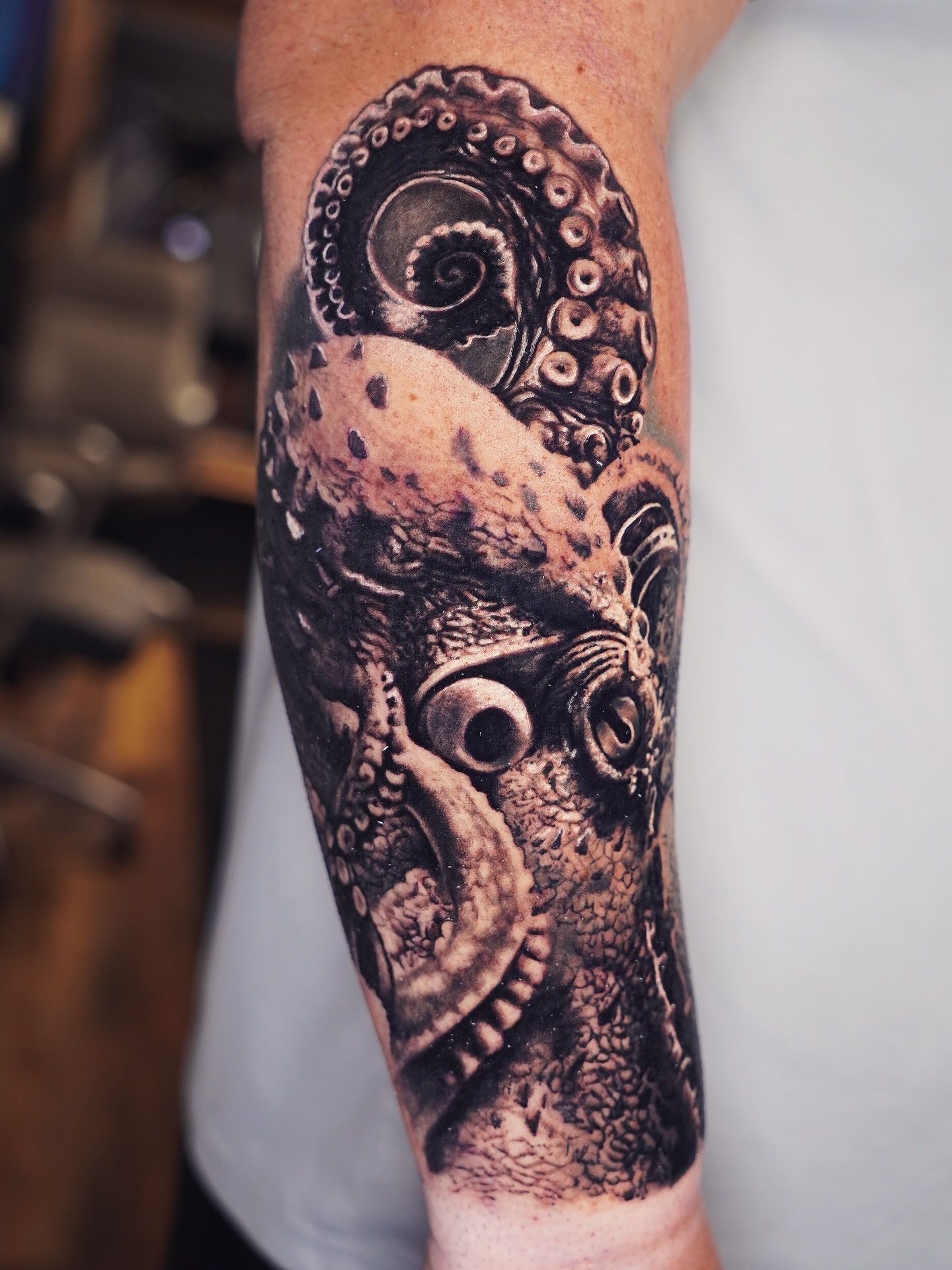
In the image above, the intricate textures of the octopus demonstrate how complex forms can occupy space. When we apply this level of detail to a cover-up, the original tattoo becomes part of the "under-shading" of the new piece. We aren't just hiding the old ink; we are reclaiming it as a tonal foundation for the new narrative. This requires a profound understanding of form and volume. We must treat the old tattoo as a shadow that we are simply refining and redirecting into a more intentional shape.
Technical Truths and the Reality of the Process
I believe in a direct and honest approach to the craft. Not every tattoo can be covered in a single session, and not every design is a candidate for a cover-up. If a previous tattoo is excessively dark, saturated, or scarred, the structural integrity of the skin may be compromised. In these cases, a few sessions of laser lightening may be necessary to "clear the canvas" before we can build something new.
Furthermore, a cover-up is often a process of building through multiple passes. The first session establishes the new composition and masks the primary shapes. As the skin heals, the underlying ink may "settle" and become slightly visible again. A second or third pass is often required to reinforce the contrast and ensure the permanence of the new image. This is the weight of responsibility that comes with the craft: we are making a second commitment to the skin, and it must be done with even greater intention than the first.
The Collaborative Dialogue: Building Your New Narrative
Every successful cover-up begins with a one-on-one consultation. This is not merely a business transaction; it is a collaborative dialogue. We must discuss the history of the piece, your vision for the future, and the technical realities of what can be achieved.
As a professional realism tattoo artist in Greenville, SC, my role is to act as a translator. You bring the personal narrative: the reason for the change: and I provide the technical expertise to interpret that narrative into a permanent, structurally sound piece of art. We look at the existing tattoo together and identify the opportunities for transformation. We don't see a mistake; we see a starting point.
Longevity: The Core Value of Quality
The ultimate goal of any tattoo, especially a cover-up, is longevity. Anyone can make a tattoo look good for a photo immediately after the session. The true test of a master is how that tattoo looks ten, twenty, or thirty years later.
This is why technical skill is non-negotiable. We must consider how the ink will spread, how the contrast will soften, and how the skin will age. By prioritizing structural depth and high-contrast composition, we ensure that the cover-up remains a cohesive piece of art for the rest of your life. We are not interested in speed or volume; we are interested in consistency and endurance.
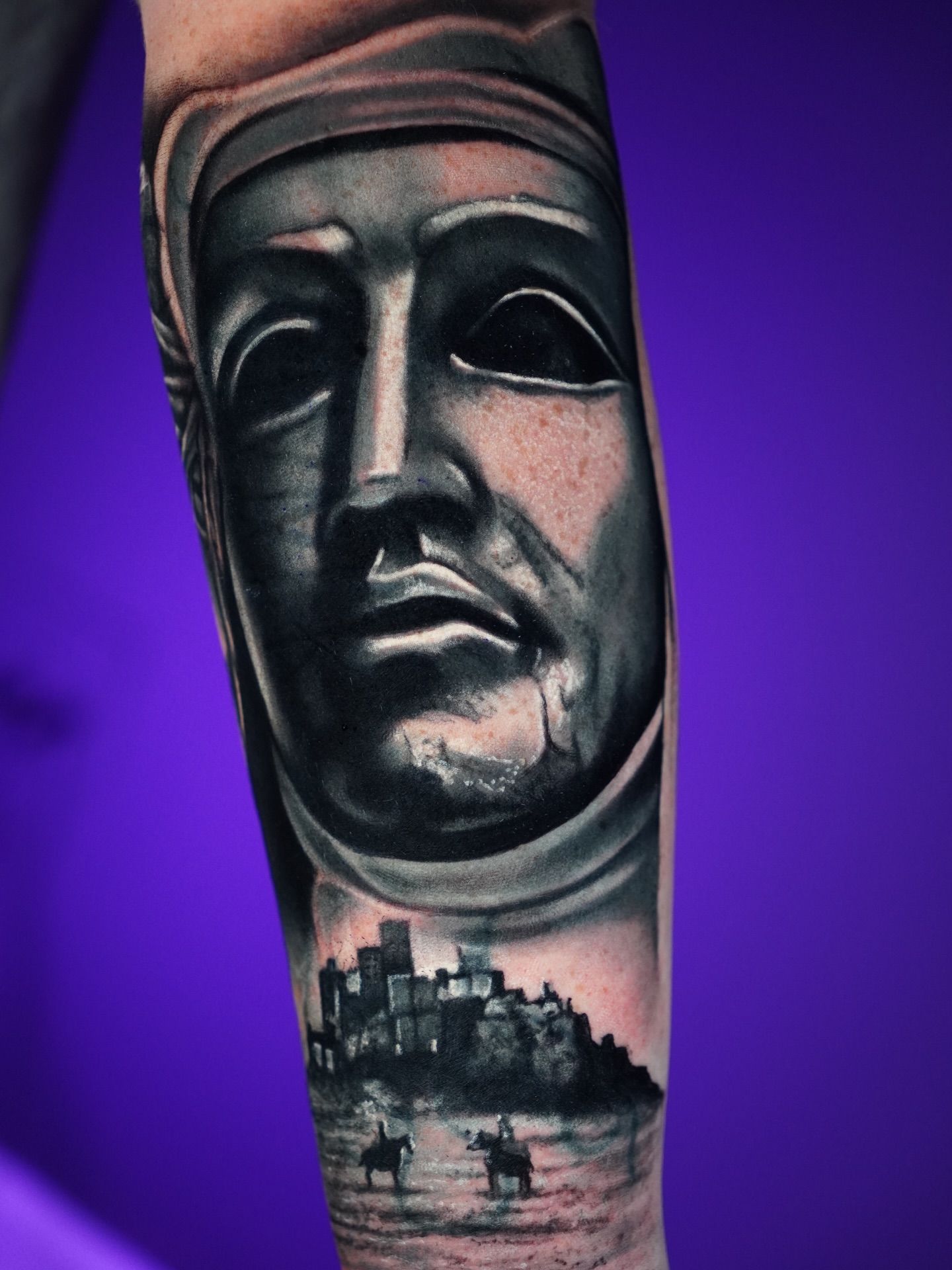
The piece shown above illustrates the level of depth and permanence we strive for. The sharp distinctions between light and shadow are what keep a tattoo readable over time. In a cover-up, this clarity is our greatest defense against the "ghosting" of the old design.
Final Reflections on the Canvas
Your skin is a living record of your journey. While some marks may no longer represent who you are, they do not have to remain as reminders of the past. Through the strategic application of black and grey realism, we can reclaim your canvas and build a new legacy of art.
If you are looking for a realism tattoo artist in Greenville, SC to help you navigate the complexities of a cover-up, I invite you to reach out. Let us begin a dialogue about your transformation. Quality requires patience, and art requires intention. Together, we can create something that reflects your current vision with the technical excellence it deserves.
For more information on the process or to view more of my work, visit my portfolio or contact the studio to schedule a consultation. Your transformation begins with a single, intentional step.